Timing can make a big difference when visiting one of Puerto Rico’s famous bioluminescent bays. While the microscopic organisms responsible for the glow are present year-round, moonlight affects how clearly you can see the bioluminescence.
The darker the night, the greater the contrast between the glowing water and the sky. That makes nights around the new moon some of the best times to experience Puerto Rico’s bio bays.
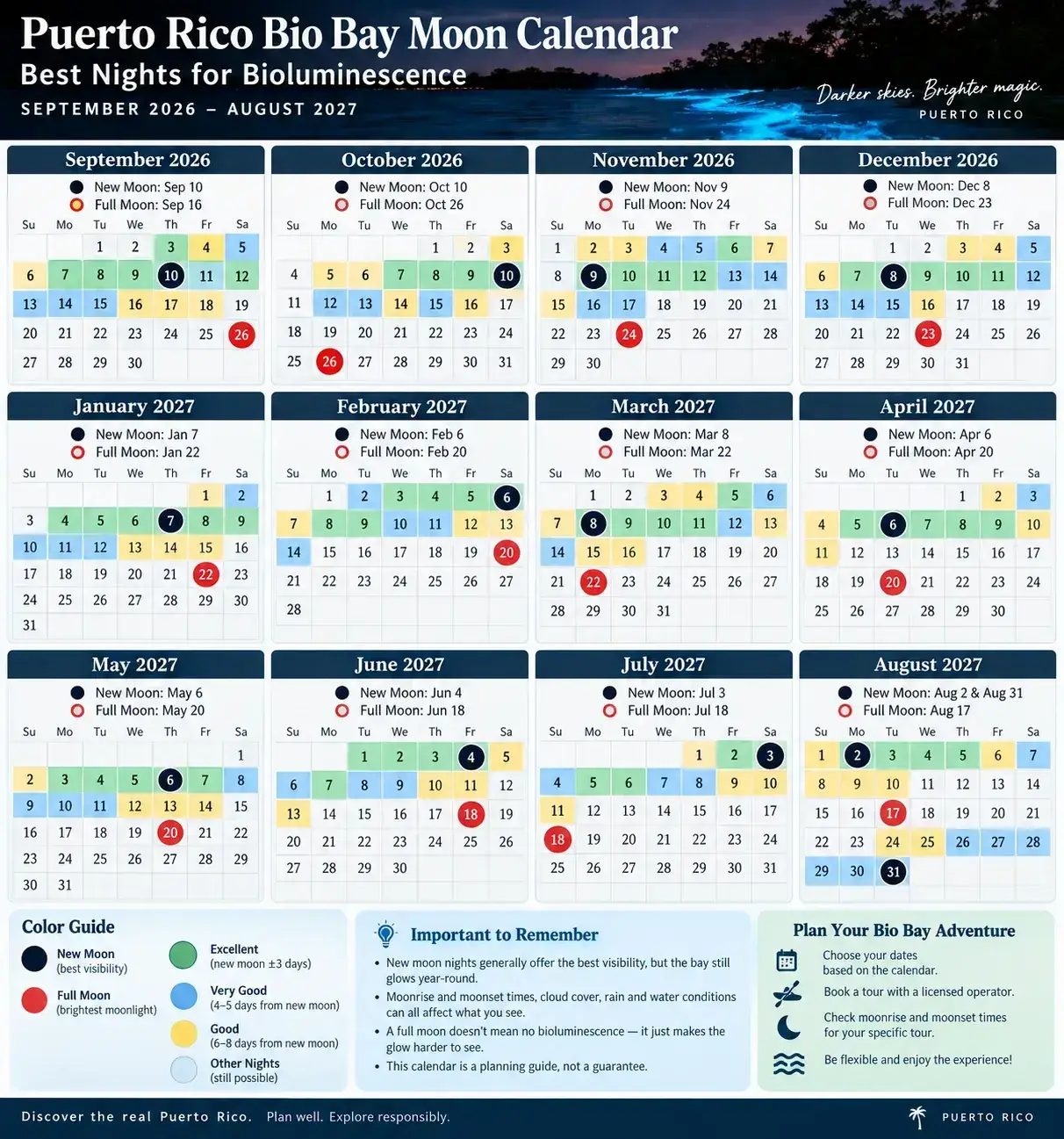
If you’re planning a visit to Mosquito Bay in Vieques, Laguna Grande in Fajardo, or La Parguera in Lajas, use our Puerto Rico Bio Bay Moon Calendar below to help choose your dates.
Quick Guide to the Ratings
Excellent — New Moon ±3 Days
These are our top picks. With very little moonlight competing with the bioluminescence, conditions are generally at their best.
Very Good — 4–5 Days From New Moon
Still an excellent time to visit. The moon may be visible for part of the night, but conditions can remain quite dark during typical tour hours.
Good — 6–8 Days From New Moon
Bioluminescence can still be impressive, although moonrise and moonset times become increasingly important.
Less Ideal — Around the Full Moon
The organisms are still there and glowing, but bright moonlight reduces the contrast and can make the bioluminescence considerably harder to see.
DPR Tip: A full moon doesn’t mean the bay stops glowing. It simply means there is more natural light competing with the glow in the water. Cloud cover and, especially, the timing of moonrise and moonset can also change the experience.
Puerto Rico Bio Bay Moon Calendar 2026–2027
September 2026
New Moon: September 10
Full Moon: September 26
Excellent: September 7-13
Very Good: September 5-6 and 14-15
Good: September 3-4 and 16-18
Best Pick
September 7-13 is the prime September window, centered on the September 10 new moon.
The new moon occurs at approximately 11:27 p.m. Puerto Rico time on September 10.
October 2026
New Moon: October 10
Full Moon: October 26
Excellent: October 7-13
Very Good: October 5-6 and 14-15
Good: October 3-4 and 16-18
Best Pick
Aim for October 7-13, with October 10 marking the new moon.
The October full moon occurs on October 26, making the latter part of the month less attractive if seeing the strongest possible bioluminescence is your priority.
November 2026
New Moon: November 9
Full Moon: November 24
Excellent: November 6-12
Very Good: November 4-5 and 13-14
Good: November 2-3 and 15-17
Best Pick
November 6–12 offers the month’s darkest moon conditions, centered around the November 9 new moon.
December 2026
New Moon: December 8
Full Moon: December 23
Excellent: December 5-11
Very Good: December 3-4 and 12-13
Good: December 1-2 and 14-16
Best Pick
Plan around December 5–11, with December 8 providing the new moon.
December’s full moon falls on December 23, so travelers visiting over Christmas should expect considerably more moonlight during evening tours.
January 2027
New Moon: January 7
Full Moon: January 22
Excellent: January 4-10
Very Good: January 2-3 and 11-12
Good: January 1 and 13-15
Best Pick
January 4–10, centered around the January 7 new moon.
February 2027
New Moon: February 6
Full Moon: February 20
Excellent: February 3-9
Very Good: February 1-2 and 10-11
Good: February 12-14
Best Pick
Target February 3–9, with the new moon occurring February 6.
March 2027
New Moon: March 8
Full Moon: March 22
Excellent: March 5-11
Very Good: March 3-4 and 12-13
Good: March 1-2 and 14-16
Best Pick
March 5-11 gives visitors the best moon conditions of the month, centered around the March 8 new moon.
April 2027
New Moon: April 6
Full Moon: April 20
Excellent: April 3-9
Very Good: April 1-2 and 10-11
Good: April 12-14
Best Pick
Look at April 3-9, particularly the nights closest to the April 6 new moon.
May 2027
New Moon: May 6
Full Moon: May 20
Excellent: May 3-9
Very Good: May 1-2 and 10-11
Good: May 12-14
Best Pick
May 3-9 offers May’s prime bio bay viewing window based on the lunar cycle.
June 2027
New Moon: June 4
Full Moon: June 18
Excellent: June 1-7
Very Good: June 8-9 and 30-11
Good: June 10-12
Best Pick
For June visitors, prioritize June 1-7, surrounding the June 4 new moon.
July 2027
Excellent: July 1-6
Very Good: July 7-8
Good: July 9-11
New Moon: July 3
Full Moon: July 18
Best Pick
The month starts with excellent conditions. July 1-6 should be the first dates to consider, with the new moon falling late on July 3.
August 2027
New Moon: August 2
Full Moon: August 17
New Moon: August 31
Excellent: July 30–August 5 & August 28-September 3
Very Good: August 6-7 and August 26-27
Good: August 8-10 and August 24-25
Best Pick
August offers a choice most months don’t: two excellent dark-sky windows. The first surrounds the August 2 new moon, while another begins at the end of the month around the August 31 new moon.
Which Moon Phase Is Best for a Puerto Rico Bio Bay?
The new moon is generally the best moon phase for seeing bioluminescence.
Bioluminescent organisms don’t become brighter because there is a new moon. Instead, the darker sky makes their light easier for your eyes to see. Bright moonlight has the opposite effect, reducing the contrast between the glowing water and its surroundings.
That’s why we recommend starting with the new-moon date when planning your trip and working outward from there.
Don’t Automatically Rule Out Other Nights
Moon phase isn’t the whole story.
The actual moonrise and moonset time can be just as important. A night with a partially illuminated moon may still provide excellent viewing if the moon hasn’t risen during your tour or has already set.
Cloud cover can also block some moonlight.
So if your Puerto Rico vacation doesn’t line up perfectly with one of our Excellent dates, don’t automatically skip the bio bay. Check the moon timing for your particular tour before making the decision.
Does the Full Moon Affect Puerto Rico Bio Bay Tours?
Yes. A full moon produces enough natural light to significantly reduce the visible contrast of the bioluminescence.
Some operators even alter their schedules or tour offerings around the brightest portion of the lunar cycle. For example, Fajardo operators may offer alternative full-moon experiences because moonlight makes the bioluminescence more difficult to see.
Tour schedules and environmental regulations can change, so always confirm availability directly with your chosen operator before planning around a particular night.
Which Puerto Rico Bio Bay Should You Visit?
Puerto Rico has three main bioluminescent bay experiences, and the moon calendar can be used when planning a visit to any of them.
Mosquito Bay – Vieques
Often considered Puerto Rico’s premier bioluminescent experience, Mosquito Bay combines exceptionally strong bioluminescence with the darker surroundings of Vieques.
Getting there requires more planning, however, since Vieques is separate from Puerto Rico’s main island.
Best for: Travelers making the bio bay a major part of their Puerto Rico itinerary.
Laguna Grande – Fajardo
Located on Puerto Rico’s east coast, Laguna Grande is the easiest of the three bio bay experiences to incorporate into a trip based around San Juan.
Most visits involve nighttime kayaking through a mangrove channel before reaching the lagoon.
Best for: San Juan visitors and travelers looking for a kayak adventure.
La Parguera – Lajas
On Puerto Rico’s southwest coast, La Parguera provides a different experience, with boat-based excursions among the options available.
Best for: Travelers exploring western and southwestern Puerto Rico.
How to Choose Your Bio Bay Date
If seeing the strongest possible bioluminescence is one of the priorities of your Puerto Rico vacation, choose your date before choosing your tour.
Start with the Excellent dates on our calendar. Then compare available tours at Mosquito Bay, Laguna Grande or La Parguera.
If those nights aren’t possible, move outward toward the Very Good and Good dates.
For dates closer to the full moon, pay particular attention to the actual moonrise and moonset times during your tour.
And remember that the moon is only one part of the equation. Weather, water conditions and natural variations in the concentration of bioluminescent organisms can all affect what you see on any particular night.
Planning Your Puerto Rico Bio Bay Adventure
A bio bay can be one of Puerto Rico’s most memorable nighttime experiences, and a little planning can dramatically improve your chances of seeing the water at its best.
For the simplest rule, remember:
The closer your tour is to the new moon, the better your chances of having a dark sky that lets Puerto Rico’s bioluminescence take center stage.
Use this calendar to identify your preferred dates, then check current tour schedules and conditions before booking.
Moon dates are based on Puerto Rico local time. This calendar is intended as a planning guide and does not guarantee the strength or visibility of bioluminescence on any particular night.